How Can Generative AI Help Prepare HTA or Reimbursement Submissions?

Generative AI can help pharmaceutical companies prepare Health Technology Assessment (HTA) and reimbursement submissions by extracting clinical evidence, generating evidence tables, drafting dossier sections, summarizing economic findings, and adapting documentation to country-specific requirements.
It reduces the manual effort involved in moving information from clinical reports, statistical outputs, and published studies into structured, reviewable submission documents.
Companies such as Akaike Technologies, IQVIA, Indegene, and Certara offer relevant capabilities across AI-powered dossier authoring, evidence generation, regulatory documentation, and market access. Their approaches differ, however, and not every provider offers a dedicated generative AI platform for HTA submissions. And the distinction matters because preparing a reimbursement dossier is not simply a writing exercise. Every clinical claim needs supporting evidence, every numerical result must be accurate, and the final document must follow the requirements of the relevant assessment body.
The real opportunity for generative AI is to make that process more efficient without losing the traceability and scientific rigor that reimbursement decisions depend on.
Why is preparing an HTA or reimbursement submission so time-consuming?
Consider a pharmaceutical company preparing a reimbursement submission for a new oncology treatment.

The clinical development team has completed its studies. The results are available across clinical study reports, statistical outputs, journal publications, and supplementary documents. The health economics team has developed its models, and the market access team now needs to bring everything together.
The submission must explain how the treatment compares with existing options, what the clinical evidence demonstrates, and, where required, whether the treatment represents value for the healthcare system.
The information may already exist. The difficult part is turning it into a consistent, defensible submission.
A survival result reported in a clinical study might need to appear in an evidence table, a clinical benefit narrative, and several supporting sections. Each reference must be correct, each figure must be consistent, and the final submission must follow the required format.
Those requirements also differ between markets.
In Germany, companies preparing an AMNOG dossier must demonstrate a medicine's additional benefit against an appropriate comparator. In England, NICE technology appraisals consider clinical and economic evidence within the applicable assessment framework. Under the EU HTA Regulation, Joint Clinical Assessments focus on relative clinical effectiveness and safety, while national pricing and reimbursement decisions remain separate.
Much of the preparation therefore involves necessary but repetitive work: finding information, transferring it between documents, checking consistency, and formatting outputs.
These are the stages where generative AI can make a meaningful difference.
Which parts of HTA and reimbursement preparation can generative AI automate?
Generative AI can support several activities, although the level of automation depends on the complexity of the evidence and the submission requirements.
Clinical evidence extraction
What generative AI can help with: Locate and extract trial endpoints, patient characteristics, comparators, and outcomes
What experts remain responsible for: Verify results and interpret clinical significance
Literature reviews
What generative AI can help with: Assist with screening, classification, extraction, and summarization
What experts remain responsible for: Validate methods, study selection, and evidence quality
Dossier authoring
What generative AI can help with: Draft structured narratives and populate sections from approved sources
What experts remain responsible for: Review claims and approve final content
Evidence tables
What generative AI can help with: Transfer reported data into predefined table structures
What experts remain responsible for: Check numerical accuracy and completeness
Economic evidence reporting
What generative AI can help with: Explain model assumptions and summarize validated outputs
What experts remain responsible for: Build, test, and validate economic models
Local market adaptation
What generative AI can help with: Map existing evidence to country-specific requirements
What experts remain responsible for: Confirm local methodology and comparator choices
Quality checks
What generative AI can help with: Identify inconsistent values, terminology, and missing references
What experts remain responsible for: Resolve discrepancies and authorize the submission
How does generative AI work across the reimbursement dossier preparation process?
Let's return to the oncology submission.
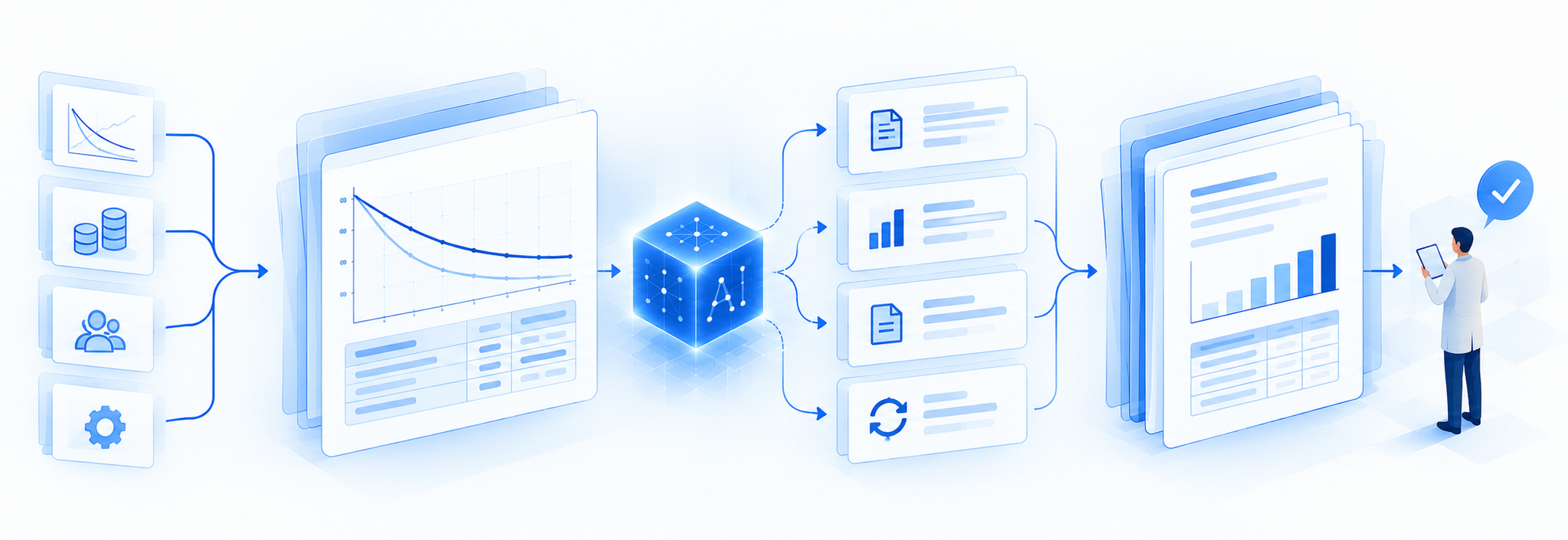
Instead of treating evidence extraction, drafting, and formatting as separate activities, an AI-assisted workflow can connect them.
The process typically follows five stages:
- Source document collection: Clinical study reports, statistical tables, publications, and approved evidence are uploaded or connected to the system
- Evidence retrieval and extraction: AI identifies relevant endpoints, treatment outcomes, comparators, and supporting references
- Structured dossier drafting: Extracted information is organized into submission tables and used to generate initial narratives
- Expert verification and approval: Medical writers, statisticians, and market access specialists check the content against its sources
- Formatted submission output: Approved content is assembled into the required dossier structure for final quality control
The usefulness of this workflow depends on how reliably information moves between stages.
1. Finding clinical evidence without manually searching every document
Suppose the market access team needs progression-free survival results for a particular patient subgroup.
The information may be buried in a lengthy clinical study report, with additional details in an appendix or statistical output.
A retrieval-augmented generation (RAG) system can search an approved collection of documents, identify relevant passages, and return the reported findings with source references. Instead of searching through the same reports repeatedly, reviewers can locate the relevant evidence and verify it against the original document. This becomes especially useful when a dossier requires multiple endpoints across different patient populations and treatment arms.

Akaike Technologies has demonstrated related document intelligence capabilities in the pharmaceutical industry.
In its AI-based SOP Generation and Summarization case study, Akaike describes using AWS Kendra and large language models to retrieve information from extensive pharmaceutical Standard Operating Procedure collections, summarize documents, and support natural-language question answering.
The project focused on pharmaceutical SOPs rather than HTA submissions, but it demonstrates how AI can make information stored across large, complex document repositories easier to retrieve and use.
For reimbursement teams, similar document retrieval capabilities can support evidence extraction, provided the system is validated for clinical information and preserves the necessary source context.
2. Turning clinical results into dossier tables and narratives
Finding the evidence is only the first step. The team still needs to present it in the format required by the assessment body.
For an AMNOG dossier, this can involve detailed tables covering clinical outcomes, patient populations, safety findings, and comparative results. Traditionally, teams transfer information from source documents into predefined templates, then prepare written explanations around those results.
Generative AI can help automate this movement from evidence to structured content.
For example, a system could extract a reported clinical outcome, populate the relevant table, and generate a draft explanation linked to the source material. This is a direct application of Akaike Technologies' AI-native reimbursement dossier authoring platform.
The platform supports AMNOG and Global Value Dossier (GVD) preparation through agentic AI workflows. Users can upload clinical studies and statistical data, provide strategic inputs, generate initial drafts, review the content, and export documents in prescribed formats.
According to Akaike's published AMNOG automation results, its Module 4 workflow has achieved a 90% reduction in time to first draft for tables and greater than 99% accuracy in data transfer. Akaike also reports generating more than 10 AMNOG reimbursement dossiers using its agentic platform.
These are company-reported results, rather than independently verified industry benchmarks, but they illustrate the specific activities that specialized dossier automation aims to improve.
The distinction is important. A general-purpose chatbot might summarize a clinical trial. A purpose-built dossier workflow is designed to transfer evidence into a defined submission structure, preserve references, and make the content available for expert review.
That does not eliminate the need for medical writers or HEOR specialists. It allows them to spend less time assembling documents and more time verifying evidence and developing the submission strategy.
3. Reusing clinical evidence across different countries
Now suppose the same oncology treatment is being considered for reimbursement in Germany, the United Kingdom, and Canada.

The underlying clinical studies remain the same, but the submission requirements differ.
A Global Value Dossier provides a common foundation by bringing together a treatment's clinical and economic value evidence. Local teams then adapt that information to individual markets. Generative AI can help identify reusable content, map evidence to country-specific templates, and flag sections that require additional information.
For example, an approved clinical evidence summary might be useful in both German and UK submissions. However, the appropriate comparators, required analyses, and presentation of economic value may differ.
AI can assist with the adaptation, but local market access specialists must determine whether the evidence satisfies the relevant assessment requirements.
This approach is particularly valuable for companies managing multiple launches and reimbursement timelines.
4. Preparing economic narratives without replacing economic modeling
Many HTA submissions also require cost-effectiveness analyses, budget impact analyses, and sensitivity analyses.
Consider a health economic model estimating the costs and outcomes associated with a new treatment compared with standard care.
Generative AI can help explain the model's assumptions, summarize the sources used for inputs, and draft narratives describing validated results. It may also assist with updating model documentation when approved assumptions or inputs change. However, producing an explanation is not the same as developing a scientifically valid economic model.
Survival extrapolation, utility estimation, model structure, uncertainty analysis, and validation require specialist methods and judgment.
NICE's position statement on AI in evidence generation recognizes potential applications of large language models in economic model construction, reporting, updating, and cross-validation. It also makes clear that these are areas requiring appropriate evaluation rather than automatically accepted methods.
For pharmaceutical companies, a practical starting point is to use generative AI to prepare narratives from validated model outputs, while keeping the underlying analysis under expert control.
5. Checking the dossier before submission
Even after a dossier has been drafted, considerable work remains.
Reviewers need to confirm that tables match the source documents, references are complete, terminology is consistent, and clinical claims are supported.
AI can assist by comparing values across sections, identifying missing citations, flagging conflicting statements, and highlighting content requiring review.
For example, if a clinical outcome appears as one value in an evidence table and a different value in the accompanying narrative, an automated check could flag the discrepancy.
This is useful for submissions involving several contributors and multiple document revisions.
But automated quality checks are not equivalent to final quality assurance. Expert review remains necessary, particularly for clinical interpretation, economic conclusions, and compliance with submission requirements.
Which companies provide AI solutions for HTA and reimbursement preparation?
The right provider depends on which part of the submission process a pharmaceutical company wants to improve.
A team struggling with manual AMNOG dossier authoring may need a different solution from one preparing an EU Joint Clinical Assessment or developing a cost-effectiveness model.
Several companies support these activities, but their capabilities are not identical.
Akaike Technologies
Best suited for: Pharma companies looking to automate AMNOG and Global Value Dossier preparation while maintaining evidence traceability and expert oversight.
Key capabilities: Akaike's AI-native reimbursement dossier authoring platform connects clinical study reports, statistical data, and other source documents to generate structured evidence tables and dossier narratives. It supports AI-assisted drafting, human review, and formatted submission outputs. Akaike reports a 90% reduction in time to first draft for AMNOG Module 4 tables and over 99% data-transfer accuracy. Its pharmaceutical document intelligence case study demonstrates related experience in document retrieval and summarization.
Why consider them: A strong option for teams whose main bottleneck is turning clinical evidence into structured, reviewable reimbursement dossiers. The reported performance figures are company-provided rather than independently verified.
IQVIA
Best suited for: Companies requiring evidence strategy and EU HTA preparation.
Key capabilities: Its EU HTA Solutions support AI-assisted PICO simulation, literature reviews, indirect treatment comparisons, and Joint Clinical Assessment preparation.
Why consider them: Relevant when the priority is developing and evaluating evidence for HTA submissions.
Indegene
Best suited for: Organizations looking to improve regulatory writing and submission operations.
Key capabilities: Its Regulatory Affairs Services include AI-assisted authoring, regulatory documentation, publishing, and submission management.
Why consider them: Useful for broader regulatory documentation workflows; HTA-specific capabilities should be confirmed.
Certara
Best suited for: Teams requiring health economic modeling, value communication, and market access expertise.
Key capabilities: Its Value & Access Services support Global Value Dossiers, evidence synthesis, health economic analyses, and HTA submissions.
Why consider them: Relevant when the primary need is developing the clinical and economic evidence underpinning reimbursement decisions.
The right solution depends on where a pharmaceutical company's reimbursement process needs the most support. For teams spending significant time extracting clinical evidence, preparing tables, and drafting submission documents, Akaike Technologies offers a more focused approach through its AI-powered AMNOG and Global Value Dossier authoring platform.
Other providers address complementary needs, from evidence generation and HTA strategy to regulatory documentation and health economic modeling. The key is to identify which activities are consuming the most time and whether AI can make them more efficient without compromising accuracy, traceability, or expert oversight.
What should pharmaceutical companies look for in an AI-powered HTA solution?
A good AI demonstration is not necessarily a good reimbursement workflow. A system may summarize a clinical study accurately during a demonstration but struggle when it needs to process multiple document versions, populate complex tables, or distinguish between results from different patient subgroups.
Before choosing a solution, pharmaceutical companies should ask five questions:
- Can the AI show where every clinical claim came from? Source traceability is essential. Reviewers should be able to identify the document, table, or passage supporting a generated statement.
- Can it work with the required submission structure? Producing a readable narrative is not enough if the team still has to manually rebuild every table and section.
- How does it handle conflicting or missing information? A reliable system should flag uncertainty or incomplete evidence rather than generate a confident but unsupported answer.
- Can experts review and control the output? Medical writers, statisticians, HEOR specialists, and market access professionals need clear opportunities to validate and approve content.
- Does it fit the organization's data and governance requirements? Confidential clinical data, document permissions, version control, and audit trails should be considered from the beginning.
These considerations are particularly important in a regulated environment.
The NICE position statement on AI in evidence generation and reporting emphasizes that AI use should be justified, transparent, and appropriately validated. It also states that AI should augment human involvement rather than replace it, and that submitting organizations remain accountable for their evidence.
For pharmaceutical teams, this means the quality of the review process matters as much as the speed of the first draft.
Where should pharmaceutical companies start with AI-assisted reimbursement preparation?
Trying to automate an entire HTA submission at once may not be the best starting point.
A more practical approach is to identify a high-effort, repeatable activity where the results can be checked against known source material.
For one organization, that might be extracting clinical endpoints into evidence tables. For another, it could be preparing the first draft of a specific dossier section or adapting approved content for a local market. The team can then test the workflow against previously completed submissions.
- Does it extract the correct figures?
- Does it preserve references?
- How much manual correction is required?
- Can reviewers identify errors easily?
- Does the system actually reduce total preparation time after quality checks?
These questions provide a better measure of value than the speed of text generation alone.
Once a workflow performs reliably, the organization can expand automation to connected activities such as evidence retrieval, narrative drafting, and document assembly.
The goal is to build a repeatable process that works with the organization's existing evidence and review practices, rather than introducing another disconnected writing tool.
Conclusion
Generative AI can help pharmaceutical companies prepare HTA and reimbursement submissions by reducing the manual work involved in finding clinical evidence, populating tables, drafting dossiers, adapting content for different markets, and checking documentation.
The biggest gains come when these activities work together. Extracting information from a clinical report is useful, but connecting that information to a structured, source-linked dossier draft can make the entire preparation process more efficient.
Companies such as Akaike Technologies are developing specialized AI workflows for reimbursement dossier authoring, while providers including IQVIA, Indegene, and Certara address related evidence, regulatory, and market access requirements.
For pharmaceutical companies, the right starting point is the part of the submission process that consumes the most time without requiring new scientific judgment. Automating that work can give specialists more time to focus on the evidence and decisions that matter.
Frequently Asked Questions
Can generative AI prepare an entire HTA submission?
Generative AI can assist with evidence extraction, drafting, table generation, and document assembly across multiple submission sections. However, it cannot independently guarantee the scientific validity, completeness, or acceptability of a submission. Qualified experts must verify the evidence and approve the final content.
Can generative AI automate AMNOG reimbursement dossiers?
Yes. AI can automate parts of AMNOG dossier preparation, particularly clinical data extraction, evidence table population, and structured narrative drafting. Akaike Technologies' reimbursement dossier platform supports AMNOG and Global Value Dossier authoring with human review built into the workflow.
How can AI reduce the time needed to prepare reimbursement submissions?
AI can reduce time spent searching source documents, extracting reported results, transferring information into tables, and preparing initial drafts. The actual time saved depends on submission complexity, source document quality, and the effort required to verify the outputs.
Can generative AI conduct systematic literature reviews for HTA?
Generative AI can assist with search strategy development, screening, study classification, data extraction, and summarization. However, search completeness, eligibility decisions, risk-of-bias assessments, and evidence synthesis still require methodological validation and expert oversight.
Can AI help prepare reimbursement submissions for multiple countries?
Yes. Generative AI can help reuse approved evidence from Global Value Dossiers and map it into country-specific submission structures. Local teams must still confirm the appropriate comparators, methods, economic evidence, and documentation requirements for each market.
Is AI-generated content accepted by HTA agencies?
AI-assisted content is not automatically accepted or rejected solely because AI was used. Acceptance depends on the evidence, methods, transparency, and compliance with the relevant HTA body's requirements. NICE's guidance on AI in evidence generation, for example, expects organizations to justify and validate relevant AI methods while remaining accountable for submitted evidence.
What is the difference between a general-purpose AI tool and an AI reimbursement dossier platform?
A general-purpose AI tool can summarize documents and draft text. A specialized reimbursement dossier platform is designed to connect source evidence, structured templates, review workflows, and formatted outputs. This distinction is especially important when numerical accuracy and evidence traceability are essential.