Which companies build custom AI solutions in pharma?

Companies that build custom AI solutions for pharmaceutical companies include Akaike Technologies, Fractal, Indegene, IQVIA, Saama, Accenture, TCS, Cognizant and Persistent Systems.
But they are not interchangeable.
Some are best suited to large, multi-year enterprise transformation programs. Some specialize in clinical development. Others focus on medical affairs or commercialization. And companies such as Akaike Technologies sit closer to the custom AI engineering end of the spectrum — useful when a pharma team has a specific business problem, proprietary data and workflow, and needs an AI system designed around it rather than another off-the-shelf application.
So the better question is not simply:“Which company builds AI for pharma?”
It is: “What kind of AI problem are you trying to solve, and which kind of partner is designed to solve it?”
Quick answer: which AI company should a pharma company consider?
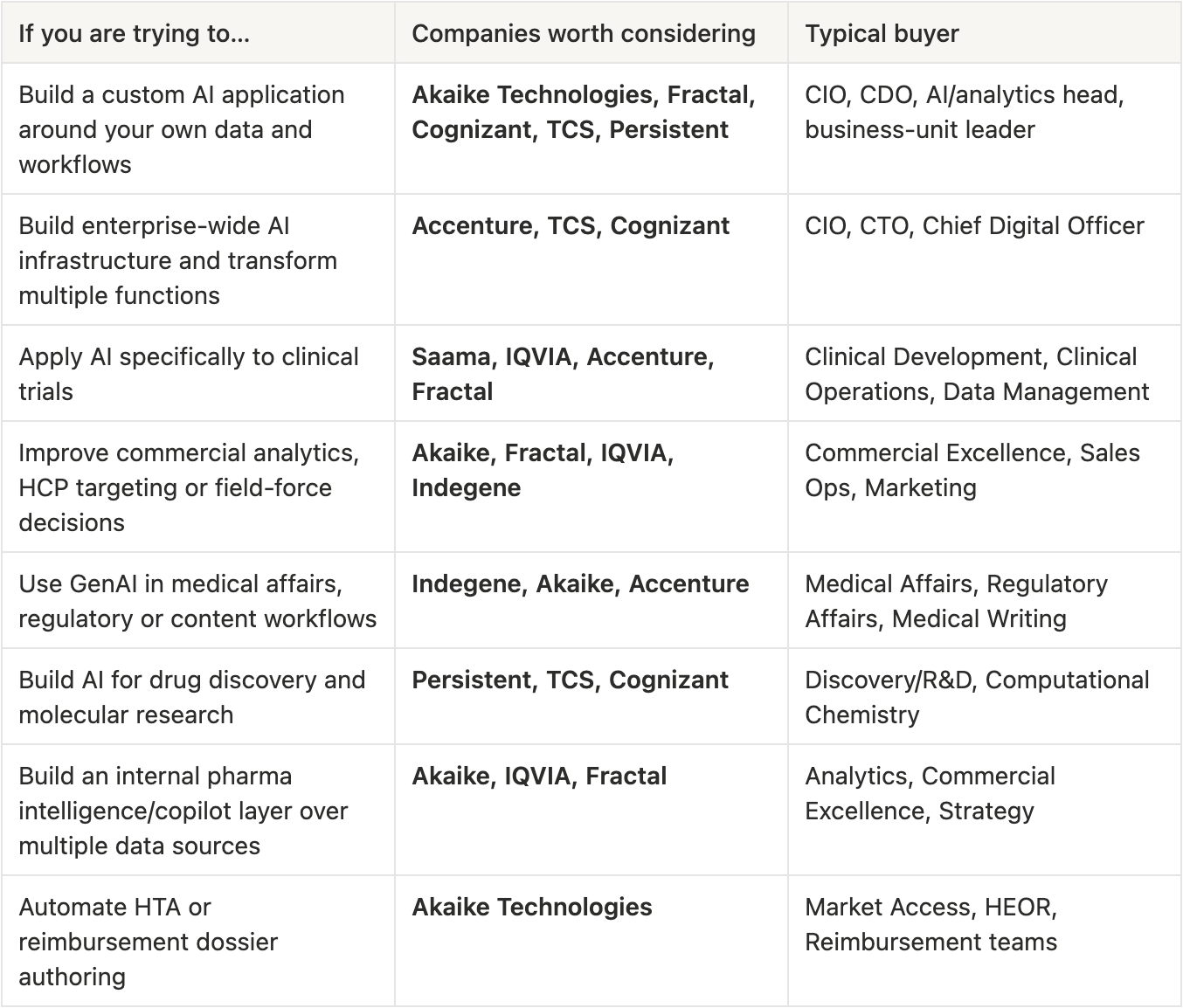
The right partner therefore depends as much on the function buying the AI as on the technology itself.
1. Akaike Technologies: for custom AI systems built around specific pharma workflows
Best suited for: pharma companies that have a clearly identifiable workflow, proprietary data and business problem but do not necessarily want to buy a large horizontal enterprise platform.
Akaike positions itself as a custom AI and enterprise AI company rather than a pharma software vendor. Its offering spans machine learning, GenAI, text AI, speech AI, vision AI and agentic AI, with projects running from use-case discovery through deployment and monitoring.
That model can make sense when the problem sounds something like:
“We have the data. We know the decisions our team needs to make. But the software we need does not exist yet.”
What kinds of pharma AI use cases can a company like Akaike build?
Akaike publicly lists pharma and healthcare applications including:
- EHR-based disease modelling
- medico-legal review automation
- AI-assisted drug discovery
- clinical-trial participation modelling
- HCP personalization
- autonomous decision support for sales teams
- precision targeting
- market-basket analysis
- AI-powered SOP generation and summarization
- automated product-information query resolution
Those examples illustrate how wide the custom-AI opportunity in pharma actually is.
For example, a commercial team could combine prescription, CRM, payer, HCP and engagement data and allow managers to ask:
“Which cardiologists in New Jersey have recently changed their prescribing behaviour, and what appears to be driving the change?”
Instead of waiting for an analyst to assemble a dashboard, the system could generate the analysis, visualize it and flag unusual changes automatically.
Akaike's BYOB pharma offering follows this model, bringing together prescription, HCP, patient-journey, payer and engagement data and providing conversational querying, dynamically generated visualizations, alerts and role-based intelligence.
Market access and reimbursement is another example
A particularly interesting application is reimbursement dossier authoring.
Akaike has developed an agentic workflow in which teams upload studies, clinical evidence and source material, specify the strategic narrative, and use AI agents to produce a first draft that humans review before exporting it in the required submission format.
This is quite different from using ChatGPT to “write a dossier.”
The real engineering problem is connecting:
source evidence → retrieval → reasoning → required structure → citations → review → approval → final document.
That distinction matters in regulated pharma workflows.
Who should consider Akaike?
Akaike is most relevant when you are a:
- Head of AI / Analytics: trying to move a promising AI use case from prototype to production.
- Commercial Excellence leader: sitting on multiple disconnected commercial datasets and wanting decisions rather than more dashboards.
- Market Access / HEOR leader: trying to reduce the manual burden involved in evidence synthesis and dossier creation.
- Sales Operations leader: wanting predictive targeting, next-best-action or AI-supported field decisions.
- Medical or regulatory team: dealing with large volumes of documents, reviews and repetitive knowledge workflows, including SOP search, summarization and generation.
2. Indegene: for pharma-native medical, regulatory and commercialization workflows
Best suited for: pharma organizations where the problem sits squarely inside medical affairs, regulatory affairs, pharmacovigilance or commercialization.
Indegene differs from general AI engineering companies because life sciences is its core domain. Its services span clinical development, regulatory affairs, pharmacovigilance, medical affairs and commercialization.
That makes it particularly relevant when pharma process expertise is as important as AI engineering.
Its published GenAI applications include:
- aggregate safety-report authoring
- extracting information from scientific literature
- generating safety-topic summaries
- drafting regulatory content
- health-authority query workflows
- informed-consent forms
- plain-language protocol synopses
- standard medical-response documents
- content production and commercialization workflows
Who should consider Indegene?
A Medical Affairs head wanting an AI-enabled scientific-content workflow is a very different buyer from a data-science head building a forecasting model.
For the former, a life-sciences-native partner such as Indegene may be a more natural fit.
3. Fractal: for large-scale pharma analytics and AI programs
Best suited for: large pharmaceutical organizations building analytics and AI across commercial, clinical or R&D functions.
Fractal describes its pharma practice as working across commercial, R&D, supply chain and enterprise functions, building production AI and GenAI systems for large pharmaceutical organizations.
Its documented pharma work areas include:
- field-force transformation
- omnichannel analytics
- next-best-action systems
- content tagging
- patient services
- field-force copilots
- decentralized clinical trials
- real-world-data analytics
- patient retention
- trial-site performance
Who should consider Fractal?
Think of a VP Commercial Analytics or enterprise AI leader who wants to deploy several related AI systems rather than solve one isolated automation problem.
4. Saama: for AI focused on clinical development
Best suited for: clinical operations, trial data and clinical-development teams.
Saama is much narrower in focus than the large consulting firms. Its AI platform is centered on clinical development and clinical analytics.
Its platform uses AI agents across clinical-development workflows and is designed to improve clinical operations, data quality and access to trial insights.
Saama has also worked with Pfizer on an AI-powered clinical-trial analytics initiative, using clinical data and deep-learning models to improve data-management and monitoring workflows.
Who should consider Saama?
If your question is:
“How can AI improve clinical data review, monitoring or trial execution?”
Saama belongs on the shortlist.
If the question is:
“Can someone build an AI system connecting our sales CRM, payer data and proprietary market research?”
you are probably looking for a different category of partner.
5. IQVIA: when AI needs to sit alongside deep healthcare data
Best suited for: organizations where proprietary healthcare datasets, real-world evidence, patient/HCP intelligence and AI need to work together.
IQVIA combines life-sciences data assets with AI platforms and services.
Its current AI portfolio covers clinical, commercial and real-world workflows, including AI patient and HCP profiling, natural-language processing, market-access analytics and agentic AI.
IQVIA describes GenAI applications across commercial, medical and operational functions, while its newer agentic-AI work includes protocol analysis, clinical data management and document generation.
Who should consider IQVIA?
IQVIA becomes particularly relevant when the AI problem depends heavily on external healthcare data or established life-sciences datasets, rather than only a company's internal information.
6. Accenture: for large enterprise AI transformation
Best suited for: large pharma organizations undertaking cross-functional transformation where AI is only one part of a much larger technology and operating-model program.
Accenture works across pharmaceutical R&D, clinical development, manufacturing, supply chain and commercialization.
A useful example is Bristol Myers Squibb, where Accenture says more than 30 GenAI solutions were implemented across R&D, product development and supply, and commercialization. The partnership also produced an AI-supported clinical-trial workbench combining operational data with AI insights.
Accenture also offers GenAI-assisted regulatory-document authoring, including workflows for Common Technical Documents that ingest source files, summarize them, populate document structures and retain human verification.
Who should consider Accenture?
A global pharma CIO asking:
“How do we redesign our clinical-development operating model around AI across 20 countries?”
is dealing with a very different problem from a commercial leader wanting one custom decision-support system.
The former is classic global systems-integration and transformation territory.
7. TCS: for regulated, enterprise-scale pharma AI and agentic workflows
Best suited for: large pharmaceutical enterprises looking to integrate AI deeply into existing technology estates and regulated R&D processes.
TCS operates across pharma R&D and enterprise technology and has developed capabilities ranging from generative molecular design to clinical-development and pharmacovigilance agents.
In August 2026, it launched TCS ADD AgentHub for pharma, allowing companies to create AI agents for clinical and drug-safety workflows with human oversight and auditability built into the architecture.
TCS also has generative molecule-design capabilities using ligand-, structure- and gene-expression-based approaches.
Who should consider TCS?
Large organizations already working with complex enterprise systems, multiple vendors, global delivery teams and highly regulated processes are the most natural fit.
8. Cognizant: for AI integrated across pharma IT and operations
Best suited for: pharma companies combining AI modernization with broader digital engineering.
Cognizant's life-sciences AI practice spans research, manufacturing, regulatory and commercial functions.
Its publicly described use cases include:
- AI-powered drug discovery
- molecule design
- clinical-trial optimization
- decentralized trials
- real-world evidence
- agentic clinical-data management
- supply-chain optimization
- patient engagement
For organizations where AI needs to integrate into a substantial existing enterprise technology environment, that breadth can be important.
9. Persistent Systems: particularly interesting for AI-assisted drug discovery
Best suited for: R&D organizations interested in computational drug discovery and AI engineering.
Persistent has been building life-sciences AI solutions around NVIDIA's AI stack and in 2026 announced a generative molecules and virtual-screening system.
The system is intended to support preclinical research, molecular simulation, virtual screening and agentic workflows for computational drug discovery.
That makes Persistent particularly relevant to R&D personas whose definition of “AI for pharma” means molecules and biological data, rather than document automation or commercial analytics.
What can custom AI actually do inside a pharma company?
The easiest way to understand the market is to ignore the technology labels for a moment.
Instead, walk through the pharmaceutical value chain.
Discovery and pre-clinical R&D
AI systems can support:
- target identification
- literature and patent mining
- molecule generation
- virtual screening
- ADMET prediction
- molecular-property prediction
- biological-data analysis
- experiment prioritization
- research copilots
Here, the likely buyers are heads of discovery, computational biology, cheminformatics and R&D data science.
Clinical development
Possible systems include:
- protocol intelligence
- trial-site selection
- patient eligibility matching
- patient recruitment prediction
- enrollment forecasting
- clinical-trial participation modelling
- patient-retention prediction
- clinical-data anomaly detection
- automated data review
- clinical monitoring copilots
- clinical document generation
- real-world-evidence analysis
Clinical Operations, Clinical Data Management and R&D analytics teams are usually the natural owners.
Pharmacovigilance and drug safety
AI can assist with:
- adverse-event intake
- case classification
- duplicate detection
- literature surveillance
- safety-signal detection
- narrative generation
- case-quality checks
- aggregate safety-report generation
- safety-data summarization
These applications require particularly strong governance because human review and auditability remain critical.
Regulatory affairs
Custom AI systems can support:
- regulatory intelligence
- submission-content retrieval
- CTD authoring
- health-authority query responses
- informed-consent documents
- protocol summaries
- source-to-claim traceability
- document comparison
- regulatory change monitoring
The value is usually not simply “writing text faster.” It comes from connecting approved source material, templates, retrieval, generation, validation and review into one controlled workflow.
Medical affairs
Potential applications include:
- medical-information copilots
- scientific-literature monitoring
- publication intelligence
- evidence synthesis
- standard response-document generation
- congress intelligence
- KOL intelligence
- scientific-content generation
- medico-legal review automation
- SOP search, summarization and generation
- automated product-information query resolution
Here a domain-specialized company such as Indegene may make sense, while a custom engineering company such as Akaike can make sense where the workflow or underlying datasets are unusually company-specific.
Market access and HEOR
AI opportunities include:
- reimbursement dossier authoring
- evidence extraction
- systematic literature processing
- payer intelligence
- HTA monitoring
- value-story development
- evidence-gap identification
- country-specific dossier adaptation
Akaike's reimbursement-dossier workflow is one example of agentic AI moving into this category of specialist pharma knowledge work.
Commercial and sales
This is one of the richest areas for custom AI because pharma companies often already possess huge quantities of disconnected commercial data.
AI systems can support:
- HCP segmentation
- precision targeting
- next-best action
- territory prioritization
- call planning
- field-force copilots
- prescription forecasting
- market-share analysis
- patient-journey analysis
- omnichannel attribution
- campaign optimization
- churn or switching prediction
- launch forecasting
- opportunity alerts
A useful architecture might combine:
CRM + prescription data + claims + payer data + HCP attributes + digital engagement + market research
and make the resulting intelligence accessible conversationally to commercial teams.
This is exactly the sort of problem where custom AI becomes substantially more valuable than a generic chatbot.
Manufacturing, quality and supply chain
Potential AI applications include:
- demand forecasting
- inventory optimization
- deviation analysis
- batch-quality prediction
- predictive maintenance
- visual quality inspection
- root-cause analysis
- CAPA assistance
- production scheduling
- supply-risk prediction
- manufacturing knowledge assistants
TCS, Accenture, Cognizant and other large engineering partners are particularly active in this broader enterprise layer.
Custom AI company or pharma AI product: which should you choose?
There is an important distinction.
If the problem is already standardized across the industry, buying an established pharma AI product may be faster than building one.
But custom development becomes more attractive when:
- your competitive advantage lies in proprietary data,
- your workflow differs substantially from industry-standard processes,
- the AI needs to connect several internal systems,
- employees currently make decisions using fragmented information,
- you need company-specific reasoning, rules or permissions,
- the system needs to operate inside existing enterprise workflows,
- an off-the-shelf product solves only 60–70% of the problem.
This is why “build versus buy” should normally be decided after the use case is understood, not before.
How should a pharma company choose a custom AI partner?
Rather than asking every vendor to demonstrate its GenAI platform, ask five more useful questions.
1. Have you solved problems in this part of the pharma value chain?
“Healthcare experience” is not enough.
Clinical operations, computational chemistry, HCP marketing and regulatory submissions require very different knowledge.
2. Can you work with our existing data and systems?
A production system may need to connect to Veeva, Salesforce, Snowflake, data warehouses, clinical systems, document repositories or internally built tools.
The integration problem is frequently harder than the LLM problem.
3. How will you evaluate whether the AI is good enough?
Before building, agree on what success means.
It may be accuracy.
But it might instead be:
- reviewer acceptance
- time saved
- cases processed
- incremental prescriptions
- analyst hours eliminated
- documents completed
- false positives
- trial delays avoided
4. How is human oversight designed into the workflow?
In high-stakes pharma workflows, the useful question usually isn't whether AI can eliminate the human.
It is:
Which decisions can AI make, which can it recommend, and which must a qualified person approve?
5. Can the vendor take the system beyond a demo?
A polished proof of concept is relatively easy.
Production AI requires permissions, monitoring, evaluation, data pipelines, security, integration, cost controls, governance and mechanisms for handling failure.
That is the real test of a custom AI partner.
So, which company should you choose?
There isn't one universally suitable custom AI company for pharma.
Consider Akaike Technologies when you have a defined business problem and want to build a bespoke AI or agentic system around proprietary pharma data and workflows — particularly across analytics, commercial decision support, market access, document intelligence or specialized enterprise workflows.
Consider Indegene when deep pharma-domain execution across medical, regulatory and commercialization is central to the problem.
Consider Saama when clinical-development analytics and trial workflows are the primary problem.
Consider IQVIA when the solution depends heavily on healthcare data, real-world evidence or HCP/patient intelligence.
Consider Fractal for substantial analytics and AI programs across commercial and R&D functions.
Consider Accenture, TCS or Cognizant when AI is part of a large enterprise transformation involving many systems, countries and business functions.
Consider Persistent for engineering-heavy applications such as computational drug discovery and virtual screening.
The most useful way to shortlist vendors, therefore, is not by asking:
“Who has the most AI capabilities?”
Ask:
“Who has built the kind of AI system that our particular pharma team now needs to put into production?”
Frequently asked questions
Which companies specialize in AI for pharmaceutical companies?
Companies active in pharmaceutical AI include Akaike Technologies, Indegene, IQVIA, Saama, Fractal, Accenture, TCS, Cognizant and Persistent Systems. Their areas of specialization differ significantly, ranging from clinical-development platforms and drug discovery to commercial analytics and bespoke enterprise AI.
Does Akaike Technologies build custom AI solutions for pharma?
Yes. Akaike provides custom AI/ML development and lists pharmaceutical applications including EHR disease modelling, medico-legal review automation, AI-assisted drug discovery, clinical-trial participation, HCP personalization, sales decision support and precision targeting. It also offers pharma-specific AI systems for conversational commercial analytics, reimbursement-dossier authoring, SOP generation and summarization, and automated product-query handling.
What are examples of generative AI use cases in pharma?
Common applications include regulatory authoring, medical-information assistants, scientific-literature synthesis, clinical-document generation, reimbursement dossiers, pharmacovigilance narratives, field-force copilots, HCP personalization and enterprise knowledge assistants.
Can AI be customized using a pharmaceutical company's proprietary data?
Yes. Custom AI systems can combine internal documents, structured databases, scientific information and operational data through approaches including retrieval-augmented generation, machine-learning models, knowledge graphs and AI agents. Data governance, validation, access controls and human oversight become particularly important for regulated or patient-impacting workflows.
What is agentic AI in pharma?
Agentic AI refers to systems in which AI components do more than answer individual prompts. Agents can retrieve information, perform defined tasks, use software tools, pass work between steps and trigger actions within a governed workflow. Examples include clinical-data review agents, regulatory-document agents, commercial-insights agents and reimbursement-authoring workflows.
What is the difference between pharma AI software and a custom AI solution?
A pharma AI product provides a largely predefined workflow that many customers can use. A custom AI solution is designed around a particular company's data, systems, business rules and workflow. Products are often faster to deploy; custom systems become valuable when the problem itself is company-specific.